

Understanding the Shared Responsibility of the Great Commission
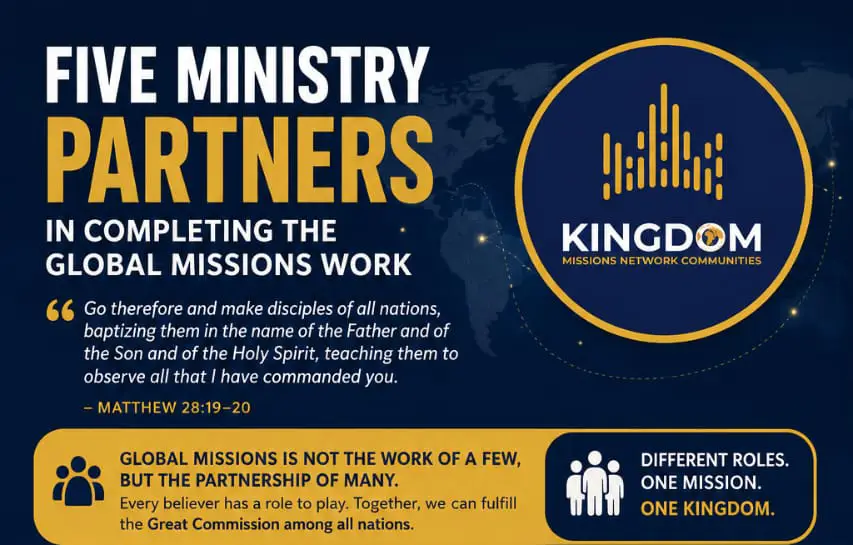
The Great Commission found in Gospel of Matthew 28:19–20 remains the central mission of the Church:
“Go therefore and make disciples of all nations, baptizing them in the name of the Father and of the Son and of the Holy Spirit, teaching them to observe all that I have commanded you.”
Fulfilling global missions is not the responsibility of missionaries alone. God calls different individuals, churches, ministries, and communities to participate in various ways so that the Gospel may reach every nation, tribe, and people group. Effective missions work is accomplished through partnership, cooperation, and shared commitment to advancing the Kingdom of God.
Below are five important ministry partners that contribute significantly to the completion of global missions work.
- Goers (Field Missionaries)
Goers are men and women who respond directly to the call of God to enter mission fields locally, regionally, or internationally. They dedicate themselves to preaching the Gospel, making disciples, planting churches, and serving communities in practical and spiritual ways.
Field missionaries often work in challenging environments, crossing cultural, linguistic, and geographical boundaries to reach unreached people groups with the message of Jesus Christ.
Key Responsibilities of Goers
- Evangelizing unreached communities
- Making and mentoring disciples
- Planting and strengthening churches
- Conducting community outreach programs
- Demonstrating Christian compassion through service
- Raising local leaders for sustainable ministry
Goers stand on the frontline of missions, carrying the Gospel into places where Christ is not yet fully known.
- Trainers (Missionary Trainers)
Missionary trainers play a critical role in equipping believers for effective ministry and missions engagement. Through biblical education, discipleship training, leadership development, and practical ministry preparation, trainers help prepare workers for the harvest field.
Without proper training, many missionaries may struggle to adapt, lead, or sustain ministry efforts effectively. Trainers therefore strengthen the quality, stability, and long-term impact of mission’s work.
Key Responsibilities of Trainers
- Conducting missionary training programs
- Teaching biblical foundations and theology
- Preparing leaders for cross-cultural ministry
- Mentoring and coaching missionaries
- Developing ministry and discipleship materials
- Building leadership capacity within churches and ministries
Trainers ensure that missionaries are spiritually mature, biblically grounded, and practically equipped for service.
- Supporters (Missionary Supporters)
Mission supporters provide the financial, material, administrative, and logistical assistance necessary for missions work to continue effectively. Many missionaries depend on faithful supporters who partner with them through giving, encouragement, and practical help.
Supporters may include individuals, churches, organizations, businesses, and ministry partners who recognize the importance of investing in Kingdom expansion.
Key Responsibilities of Supporters
- Providing financial sponsorship
- Supplying ministry resources and equipment
- Supporting missionary travel and accommodation
- Assisting with administration and coordination
- Encouraging missionaries emotionally and spiritually
- Mobilizing additional mission resources
Through their generosity and partnership, supporters make it possible for missions work to reach more communities and nations.
- Intercessors (Missionary Intercessors)
Intercessors are prayer partners who stand spiritually with missionaries and missions organizations. Missions work involves spiritual challenges, opposition, and difficult circumstances that require continual prayer support.
Intercessors help create spiritual covering for missionaries, ministry teams, churches, and communities being reached with the Gospel.
Key Responsibilities of Intercessors
- Praying for missionaries and mission teams
- Interceding for unreached nations and communities
- Engaging in fasting and prayer movements
- Seeking divine guidance for mission strategies
- Praying for protection, provision, and spiritual breakthrough
- Encouraging churches to prioritize missions prayer
Prayer remains one of the most powerful contributions to global missions because it invites God’s intervention, direction, and power into ministry efforts.
- Receivers (Missionary Receivers)
Receivers are individuals, churches, communities, and organizations that welcome missionaries and respond positively to the Gospel message. They provide local cooperation, hospitality, cultural understanding, and partnership that help missions efforts become fruitful and sustainable.
In many cases, receivers eventually become disciple-makers, ministry leaders, and missionaries themselves within their own communities.
Key Responsibilities of Receivers
- Welcoming and hosting missionaries
- Supporting local ministry implementation
- Assisting with cultural orientation and community integration
- Participating in discipleship and church development
- Becoming local witnesses and evangelists
- Helping establish sustainable local ministries
Receivers are essential because missions is ultimately about transformed lives, transformed communities, and the multiplication of disciples.
Conclusion
Global missions succeed when the Body of Christ works together in unity and shared responsibility. Some are called to go, others to train, support, intercede, or receive. Every role is valuable and necessary in fulfilling the mission of Christ among all nations.
The Great Commission is not limited to a select few; it is a calling for the entire Church. Through partnership and collaboration among these five ministry partners, the Gospel can continue advancing to the ends of the earth.
As the Church responds faithfully to this calling, the vision of making disciples of all nations becomes increasingly achievable for the glory of God.
By Brother Apostle Dr Celestin Ngirabakunzi
Kingdom Missions Network Communities (KMNC)
https://kmnc.africa

